
Incomplete Slab Leak Diagnosis and Risky Repair Recommendation
Property Type: Commercial Office
Flooring Type: Carpet with thick, compressible padding
Case Focus: Improper leak diagnosis and recommendation for destructive slab access
Performed By: Pegasus Leak Detection
Project Overview
The client reported several clear indicators of a plumbing leak before any contractor arrived on site.
Initial Symptoms
- Audible hissing noise
- Clear sound of running water
- Warm flooring in the office area
A leak detection company was dispatched by the client’s home warranty provider. The client did not independently select the contractor.
The contractor placed tape on the carpet marking an alleged leak location and recommended jackhammering through the finished flooring.
No written report or documentation was provided.
Site Conditions Upon Our Arrival
When Pegasus Leak Detection inspected the property, several concerning conditions were observed.
Physical Observations
- A large taped “X” on the carpet marking the alleged leak location
- Carpet was not removed by the previous contractor
- Carpet and padding were thick and compressible, noticeably sinking under foot pressure
Additional Information From the Client
The client reported that:
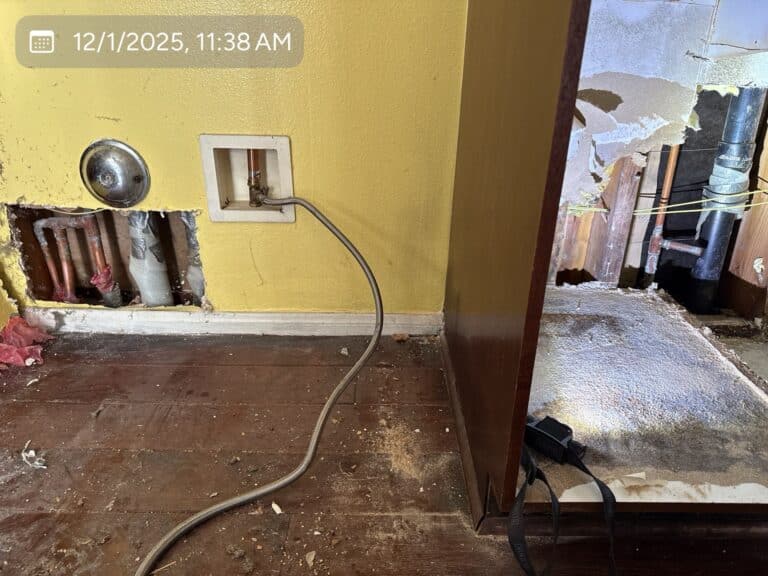
- Loud hissing was clearly audible near washing machine supply lines located behind the office wall
- The prior contractor appeared to use an infrared camera
- The contractor verbally claimed ultrasonic equipment was used to locate the leak
No written findings or diagnostic documentation were provided.
Critical Concerns Identified
Several aspects of the prior investigation raised significant technical concerns.
Lack of Professional Documentation
Professional leak detection services must provide written documentation outlining:
- Diagnostic methods used
- Testing sequence
- Equipment applied
- System isolation procedures
- Diagnostic limitations
- Confidence level of findings
Without documentation:
- There is no technical transparency
- The property owner cannot verify what testing was actually performed
- The contractor maintains full narrative control over the diagnosis
The absence of reporting represents a failure to meet basic professional standards.
Recommendation for Destructive Access Without Alternatives
The prior contractor recommended jackhammering through the slab without presenting any alternative repair strategies.
The customer was unaware that the slab likely contained a vapor barrier (damp-proof membrane).
Penetrating a slab with a vapor barrier can:
- Permanently compromise moisture protection
- Introduce long-term vapor intrusion risk
- Create structural liability
- Prevent restoration of the original moisture control system
No discussion was provided regarding:
- Reroute options
- Manifold mapping
- Long-term repair planning
In soft copper manifold systems, rerouting is often less invasive and more permanent than slab penetration.
Failure to present this option indicates either incomplete system evaluation or insufficient diagnostic expertise.
Questionable Ultrasonic Representation
The prior contractor reportedly stated that ultrasonic equipment detected a distinct subsurface hissing sound.
However, several technical conditions contradict that claim.
Acoustic Limitations Present on This Site
- Ultrasonic microphones amplify existing environmental sound
- Carpet and thick padding dampen acoustic transmission
- No direct contact with exposed concrete was performed
- The carpet was not removed
- Thick padding further reduced acoustic coupling
Meanwhile, the customer reported a clearly audible hissing noise from washing machine supply lines located behind the wall.
The marked leak location was only inches from that wall.
Because ultrasonic microphones amplify surface noise, it is highly plausible that:
- The technician detected the obvious above-ground hissing
- The sound was interpreted or represented as subsurface confirmation
Proper acoustic slab diagnostics require:
- Direct contact with exposed concrete
- Isolation of background noise
- Structured grid-based listening
None of these procedures were documented.
Overreliance on Infrared Imaging
Infrared thermal imaging can assist in leak investigations but cannot confirm leak locations on its own.
Several technical factors limit its reliability in this scenario.
Thermal Behavior of Slab Plumbing
- Hot water lines may reach approximately 140°F
- Copper pipes conduct heat beyond the leak location
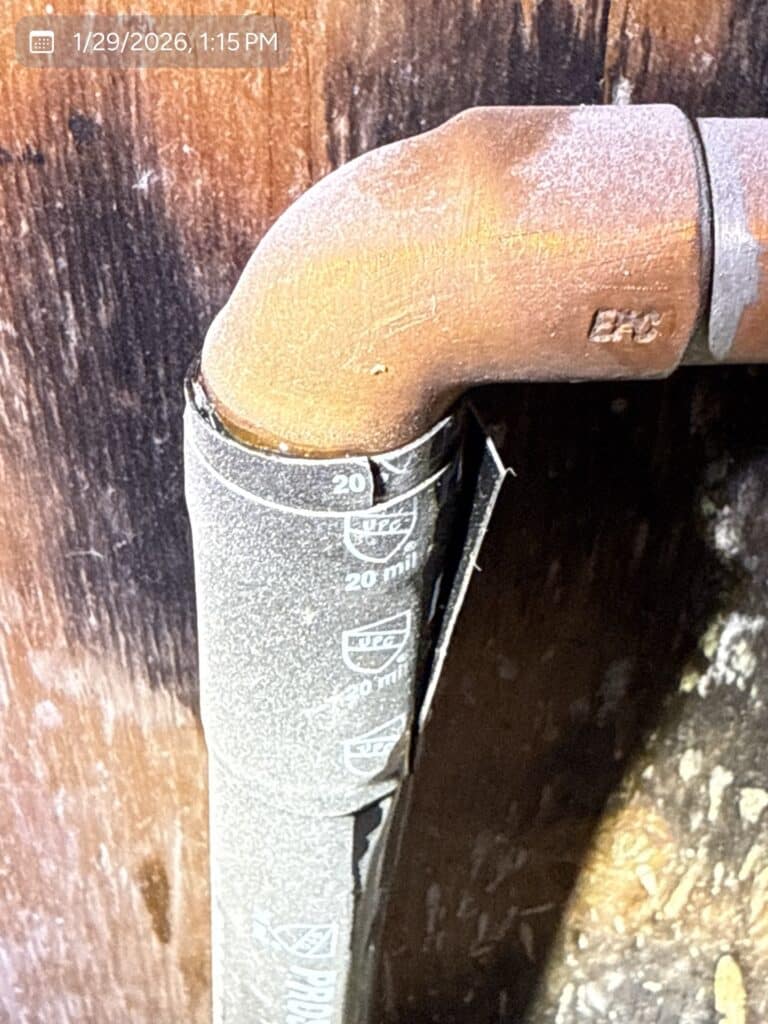
- Soft copper manifold systems often:
- Travel beneath the slab
- Gradually rise into walls near fixtures
Because of this:
- Pipe sections beyond the leak remain hot
- Heat signatures may appear stronger near wall transitions
- Infrared cameras often highlight the warmest pipe section, not the failure point
Without acoustic confirmation and system isolation, thermal imaging alone cannot reliably pinpoint slab leaks.
Broader Industry Pattern
This case reflects several recurring industry issues.
Common Problems Observed
- Warranty-directed vendor dispatch
- Emphasis on speed rather than technical accuracy
- Lack of written reporting standards
- Destructive recommendations without alternatives
- Failure to disclose structural risks
- Equipment claims without documented methodology
Owning infrared or acoustic equipment does not qualify a contractor to perform leak detection.
Leak detection is a specialized diagnostic discipline requiring structured methodology and technical experience.
Pegasus is frequently contracted by companies that advertise leak detection services but lack the technical framework to perform them properly.
Why Industry Regulation Is Necessary
This case highlights the need for several industry reforms.
Recommended Standards
- Mandatory written reporting
- Documented testing procedures
- Disclosure of structural risks
- Separation between plumbing repair and leak diagnostics
- Certification standards for acoustic and thermal diagnostics
- Transparency in warranty-dispatched vendor relationships
Without regulation, consumers remain vulnerable to:
- unnecessary demolition
- incomplete diagnostics
- structural damage without informed consent
- lack of accountability
Final Conclusion
In this investigation:
- The customer reported clear audible leak indicators before contractor arrival
- Carpet and padding conditions limited proper acoustic testing
- No written documentation was provided
- Destructive slab penetration was recommended prematurely
- Structural considerations were not disclosed
- Infrared imaging likely served as the primary locating method without adequate verification
Professional leak detection must be:
- Technically defensible
- Verified using multiple diagnostic methods
- Fully documented
- Non-destructive whenever possible
- Transparent in methodology
This case demonstrates why leak detection must be treated as a specialized diagnostic service, not a plumbing add-on.
Industry regulation and reporting standards are essential to protect property owners from incomplete diagnostics and unnecessary structural damage.