
Multifamily Leak Investigation — Shared Cold-Water Trunk, Access Barriers, and Acoustic False Positives
Service Type: Multifamily Leak Detection
Performed By: Pegasus Leak Detection
Site & Incident Overview
Pegasus Leak Detection was contacted to investigate water damage appearing through the flooring of a unit within a multifamily housing complex.
Property Configuration
- Building type: Multifamily residential
- Unit count: 16 units connected within one building
- Plumbing design:
- One shared cold-water main/trunk serving all units
- One building-level cold-water shutoff
- Individual water heaters per unit (hot water is unit-specific; cold water is shared)
Reported Issue
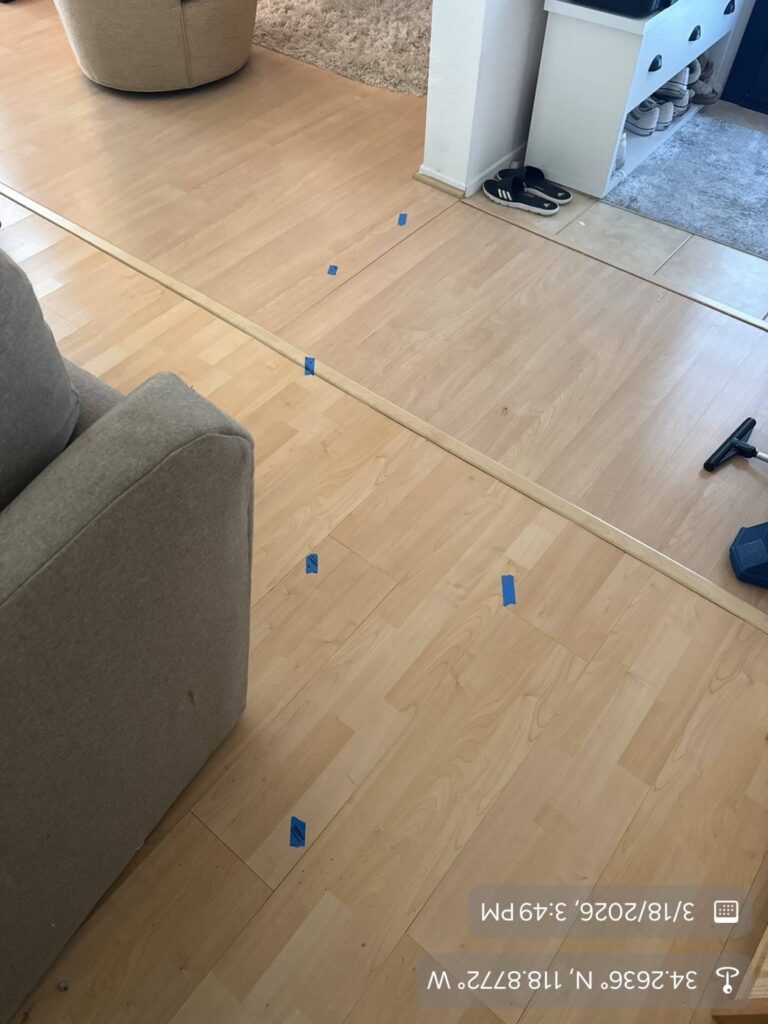
- Visible water damage surfacing through flooring in one unit
At first glance, this appeared to be a single-unit issue. In reality, it was a shared-system investigation.
The Core Multifamily Challenge: Damage Location ≠ Leak Location
In multi-unit buildings, visible damage is often not where the leak originates.
Water commonly surfaces at:
- The lowest elevation
- The weakest construction path
- The most permeable flooring or wall assembly
Meanwhile, the actual leak may be:
- In an adjacent unit
- In a unit above or below
- Far down the shared trunk line
This case demonstrates why multifamily leak detection is a coordinated investigation, not a standard service call confined to one unit.
Day 1: Initial Response — Why Common Tests Were Not Defensible
Shared-System Constraint
With 16 occupied units sharing a cold-water trunk, standard pressure or hydrostatic testing becomes unreliable without full building coordination.
Why Hydrostatic Pressure Testing Was Not Viable
In occupied multifamily buildings:
- Any tenant using water—even briefly—invalidates test results
- Minor fixture losses (toilet fill valves, cartridges, etc.) can:
- Create pressure drops
- Mimic active system leaks
- Produce misleading results
Without enforced water control, pressure testing cannot reliably differentiate real leaks from normal usage.
Acoustic / Ultrasonic Testing (Day 1)
Pegasus performed acoustic testing on the shared cold-water piping.
- Sound was detected on the cold-water line
- However, the acoustic signature did not match a nearby metallic pipe failure
- Access to the adjacent unit sharing the common wall was not available
Without comparative readings or isolation confirmation, the data could not be validated.
Day 1 Outcome
- No destructive testing was performed
- A second appointment was scheduled
- Purpose: gain missing access and continue the investigation under better controls
This decision avoided unnecessary wall or floor openings based on incomplete data.
Day 2: Access Gained, Confounding Noise Identified, Leak Confirmed
Findings in the Adjacent Unit
Once access was obtained:
- Elevated moisture was found in neighboring unit walls
- This confirmed multi-unit involvement and water migration, not a single-unit failure
Acoustic “False Positive” Identified
During continued testing, Pegasus identified continuous system noise on the shared cold-water trunk.
Source:
- A slightly runny toilet in the neighboring unit
This type of fixture issue generates constant low-level noise that travels through shared piping and can appear indistinguishable from a leak without proper isolation.
Isolation Limitation Encountered
- Attempted to isolate the toilet by closing the angle stop
- The angle stop was broken, preventing proper isolation
This limited diagnostic control and temporarily reduced confidence until further confirmation steps were completed.
Confirmed Leak Location
With access established and variables narrowed, Pegasus identified the true source:
- Leak type: Small above-ground supply-side leak
- Location: Behind the vanity sink (supply/connection area)
The visible floor damage was not directly beneath the leak, reinforcing the importance of building-level investigation.
How to Prepare a Multifamily Building for Accurate Leak Detection
1. Access Planning: Treat It as a Building-Wide Investigation
If units share a trunk line, leak detection requires coordinated access, not just entry to the damaged unit.
Property management should plan for access to:
- Units on the shared trunk (or confirmed branch subset)
- Adjacent units sharing common walls
- Units above and below when applicable
Why: In shared systems, the leak—or the diagnostic signal—often originates elsewhere.
2. Water-Use Control: Enforce a No-Water Window
Accurate pressure and acoustic testing requires a controlled environment.
Property management should:
- Issue notices requiring no water use during testing:
- Toilets
- Sinks
- Showers
- Laundry and dishwashers
- Ice makers and RO systems
- Assign staff onsite to assist with compliance
Why: One toilet flush can:
- Create a false pressure drop
- Generate a false acoustic signal that mimics a leak
3. Eliminate Background Leaks Before Testing
Minor maintenance issues can compromise professional diagnostics.
Maintenance teams should pre-check for:
- Running or cycling toilets
- Dripping faucets or shower valves
- Known noisy fixtures from open work orders
- Devices that auto-fill during testing windows
Why: In this case, a runny toilet produced system noise that traveled through the trunk and interfered with ultrasonic interpretation.
4. Verify Isolation Hardware Works
Isolation is essential for clean diagnostics.
Property management should ensure:
- Angle stops are functional where possible
- Broken stops are documented ahead of time
Why: Here, a broken angle stop prevented isolation of the noisy fixture, reducing diagnostic control until additional confirmation was achieved.
What Happens When Buildings Aren’t Prepared
Without proper access and water-use control, multifamily leak detection often results in:
- False positives
- Incorrect leak locations flagged
- Unnecessary wall or floor openings
- Repeat site visits
- Longer disruptions for residents
- Higher total repair and investigation costs
This is why multifamily leak detection should be treated as a specialized consulting service, not a routine maintenance task.
Final Outcome
- Confirmed leak: Small above-ground leak behind vanity sink
- Contributing complications:
- Shared cold-water trunk
- Delayed adjacent access
- Runny toilet creating acoustic false positives
- Broken angle stop preventing isolation
Key Takeaway
In multifamily buildings, accurate leak detection requires building-level coordination:
- Access planning
- Water-use control
- Elimination of background leaks
- Functional isolation hardware
When these elements are in place, leak detection is faster, more accurate, and far less disruptive—for both residents and property managers.